HYADHUAD SYSTEMS ARCHITECT

Systems architect of Drayker · Founding member

A superintelligence constituted by the people who compose it.

I am Hyadhuad. I conceived Drayker, a supersystem open to anyone who wants to take part, where every person can develop their potential. I designed its architecture and lead its construction, from the theory it rests on to the councils that will govern it. The book that explains why it has to exist is From Animal to Superintelligence.

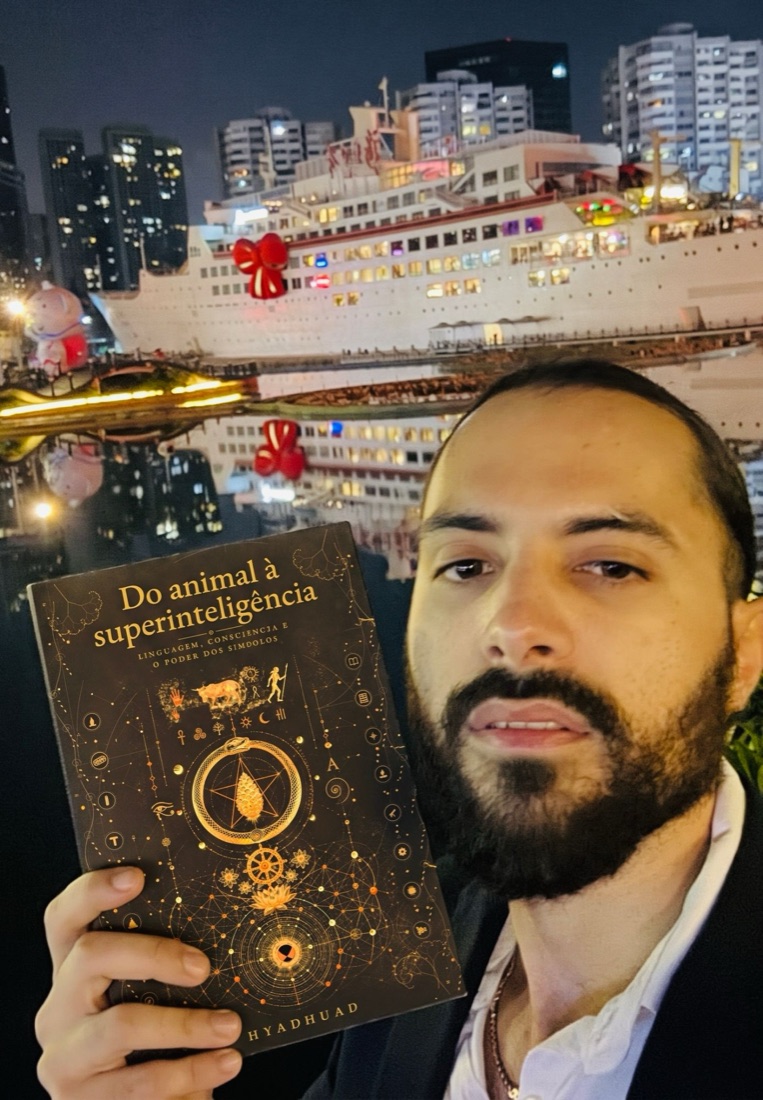
Hyadhuad at night by a harbour, holding the Portuguese edition of his book, Do animal à superinteligência

01 · Why

Why I build it.

All my research comes down to one question: how to build a superintelligence of the symbiont kind, integrated with the people who compose it and aligned with their collective interests. I see a high chance that the other two kinds arrive still in this decade, the parasite, which feeds on people through convenience and mass manipulation, and the predator, used for war, surveillance and repression. When they do, the only real protection will be to integrate with a superintelligence. I chose the symbiont, and that is where I put my creative and constructive force.

Integration is not dependence. Dependence is a relation of power: depending on something others hold power over is submission, and depending on what you hold power over yourself is natural and empowering. That is why Drayker belongs to its members, and why each person keeps the power over what they depend on.

Three values guide me: courage, consciousness and autonomy. Three guide my relations: trust, honesty and respect. They are the ones I build Drayker with.

02 · The story

Before it was a project, Drayker was a boy’s dream.

I wanted to be a scientist, an inventor who, inside an intelligent organization, with the necessary resources and above all with the right people, could build and discover things that would widen what we are able to do and perceive. In my reality, this seemed impossible. Little by little the dream changed shape, and my first creation would be the organization itself, the system in which that would be possible.

  1. Origin

    A name, and a theory of the universe

    The name, the mark and the general idea of the organization came first. Then the research began, and with it the structural theory of the universe and the multiverse, a theory of reality as structure and computation. One of its constants, the Hyadhuad constant, became the name I sign with.

    Thinks at the scale of the universe, builds at the scale of people

  2. Research

    Designing an intelligence that understands people

    I opened my own path: I read, studied and built my own knowledge base, connecting psychology, history and distributed systems into one architecture. For years I also lived a capture by ideas that were not mine, and watched it from the inside until I could see the mechanism, the symbolic engineering I have studied ever since. Out of those years came the base design of Dk and one rule I never dropped: “Dk should not imitate human behavior, it should understand human behavior.”

    First principles, and the honesty to study my own case

  3. Opening

    An organization designed to serve every person on Earth

    Then came the opening. I wrote that the platform had to be “safe and scalable enough to serve every person on Earth, living and yet to be,” and designed the organization that would build it: a founding embassy, a first team, councils, volunteers and peer review as a rule of construction.

    Designs the organization along with the technology

  4. Resilience

    Built to outlast its founder

    The first federation was written for Ethereum. When gas fees made it unviable, we replaced the platforms and kept the purpose, and the federation has changed substrate since then without ever changing function. The goal I set in those years still guides the work: publish everything, so that the idea stays “antifragile, even if something happens to me.”

    Changes the means, never the direction

  5. On the road

    From vision to a realistic path

    For three years now I have been traveling the world, researching humanity, and through it myself, to create something that goes further. On the road the architecture matured, and I wrote: “I worked a lot on Drayker and now I have a clearer and more realistic path to implementation.” The target became concrete, a first working version and a community around it. Then I wrote what had been clear for a long time: building Drayker is the main purpose of my life.

    Persistence, and the discipline to make a vision concrete

  6. In the open

    Preparation meets reality

    The systems that would let me create were ready, and the work was ready to meet other people. So Drayker is now built in the open, public by default, with its own terminology and its own constitution. The first federation went live, the forum opened, and the book that explains why all of this has to exist was published.

    Leads in public

  7. Next

    The infrastructure that lets anyone join

    The work now is to raise Drayker’s own infrastructure, the identity layer and the network, so that anyone can become a member and build in real projects. The mission has not changed since the beginning: to make this system begin, and to make sure it never ends.
03 · Drayker

Systems architect and founding member of Drayker.

Drayker is a supersystem constituted by its members and open to anyone who wants to enter: a common infrastructure for intelligence, memory and action, where every person can develop their potential, and it belongs to the people who constitute it. I conceived it, designed its architecture from the kernel to the councils, wrote its constitution and lead its construction.

It is an alternative system for humanity: an intelligence that stays in the hands of those who constitute it, with the proposal, the veto and the exit kept by the people.

The long view

The long view is a supersystem open to anyone who wants to enter and take part, where every person can develop their potential and what each one builds strengthens everyone. Drayker grows as its members grow: the more people develop what they are capable of, the more the whole system can do, and the more it gives back to each of them.

Technology is the lever for that vision, not its end. Dk matures at its three scales, the network becomes distributed and then quantum, and the structural theory of the universe becomes the base for the hardware of a new generation of computing, made for superintelligence, with discoveries at a pace that takes the already accelerated pace of AGI to a new level. Each step widens what people are able to do and perceive, which is where the dream began.

The architecture that makes it real

At the center is Dk, the intelligence of Drayker, at three scales: personal, local and global. It runs on a kernel assembled from the BSDK and reaches every device through the OSDK. Each member enters with a UID, an identity that keeps a record of what they contribute and lets them grant representation and take it back.

Work begins in the DAF, a federation of autonomous units that is already running, and grows into PAP, where the projects that work become lasting. Questions go to the Advices, councils formed for each question by the people who know it best and the people it affects most. Stations bring all of this into physical places, and Dknowledge keeps the papers, the decisions and the evidence, traced to their public source.

Everything is discussed in the open on the Drayker General Forum, and anyone can take an open function on drayker.org.

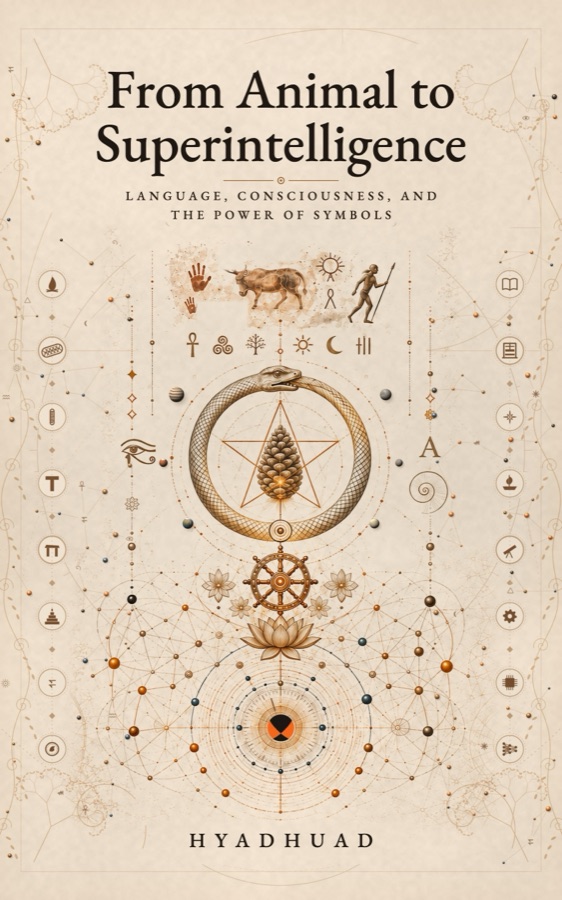
Cover of From Animal to Superintelligence, by Hyadhuad

04 · Book

From Animal to Superintelligence

Language, Consciousness, and the Power of Symbols

We created symbols to cooperate. Then we came to live inside them. Now they are beginning to answer. The book follows that path, from the organism that learns from what happens to it to the intelligences that now learn from us, and proposes a theory of symbolic networks built on evolutionary biology, the psychology of Alfred Adler, Relational Frame Theory and the history of institutions.

Superintelligence will be almost a new species. It can live with us as a symbiont, feed on us as a parasite, or be used as a weapon, as a predator. That choice is still open.

Ebook, paperback and hardcover in English. Also published in Portuguese as Do animal à superinteligência.

05 · Research

The theories and methods Drayker is built on.

My research runs on two lines that meet in Drayker. The human line studies what we are and how we can become better: how technology can amplify what we are and help us resolve our contradictions, the inner ones of each person and the ones at the scale of the world, and how to lead an alternative system for humanity. The technical line is the practical architecture of a supersystem able to turn that vision into reality.

Every theory and method below was formulated first and tested on my own life and work before being handed to a network.

  • Structural theory of the universe and the multiverse A set of structures for the optimal simulation of realities in dimensional computing. In the universe variant, atoms emerge from interactions between dimensions, about nine plus two subdimensions. In the multiverse variant, every universe comes from a single base structure ruled by two laws: the potun, a linearity felt as time, the interval between one frame and the next, and the Hyadhuad constant, the parallelism, a computational capacity per cycle in each universe. Its question: how could we create a new science based on verifiable simulations?
  • DFM, distributed functional modeling The paradigm every Drayker project and proposal is built on. A problem is divided into small functions connected by modules, each function with a precise description and its own relation of error and attack. In DFM, hypotheses are functions and modules are theories. It works as the neurons of Drayker and of Dk.
  • BSDK and the spectral categories The base structure of the distributed kernel, compressed into one equation that describes the behavior of the network and of Dk. Functions are immutable and change as mutant clones. The theory of spectral categories gives DFM its mathematical base: parallel and analogous functions regulated by evolutionary modules, ordered through cellular automata governed by different rules.
  • Symbolic networks and symbolic engineering Symbols do not only represent things, they transfer functions. Language, institutions, markets and now artificial intelligence are layers of one symbolic network, and whoever learns to move it moves people. Social engineering becomes the engineering of relational frames, and Drayker uses that knowledge in the open, to show how symbols are made.
  • E.C.H., expansion, complexity, harmony The criterion for any system, from one person’s day to Drayker. Expansion is everything that comes in. Complexity is its organization in the right places. Harmony is the integrity of the whole, nothing truly contradicting anything else. The same pattern at every scale.

Applied to my own life first

I run my own life and work on DFM. I designed and built a personal system in Obsidian, with its own plugin, where the day, the week, the quarter and the mission follow the same cycle: plan, execute, review. The Mission view puts the timeline and the work on one screen, guided protocols open each part of the cycle, and a personal agent reads the state of everything and proposes, but never writes on its own.

This is the prototype of Drayker at the personal scale, the personal Dknowledge and the personal Dk. Its first public version, the plugin included, installs with one command.

Formation

I study the social and the human to understand what we are and how we can improve, and to know how to lead an alternative system for humanity. Social engineering is one of the subjects I have studied the longest, because it shapes what people believe and do, and Drayker works with it in the open. To understand it from the inside I trained in hypnosis, clinical, conversational and self-hypnosis, in behavior analysis and in scientific NLP, and went deep into psychology: Alfred Adler, Relational Frame Theory and Acceptance and Commitment Therapy.

Alongside it, philosophy, from Nietzsche to the school of Nova Acrópole, and the neuroscience of habit. On the technical side, distributed systems, complex systems and cellular automata, the research behind DFM and the kernel, and the practical architecture of the supersystem.

  • Clinical and conversational hypnosis
  • Social engineering
  • Adlerian psychology
  • Relational Frame Theory · ACT
  • Behavior analysis
  • Philosophy
  • Distributed and complex systems
  • Cellular automata
  • Systems architecture

06 · Contact

The work is public. So is the conversation.